Once in a field, diseases are unlikely to be completely controlled through the eradication of a pathogen. However, effective disease management can reduce the effect of a disease on subsequent crops and the risk of the disease spreading between fields and farms.
It is important to be informed about what diseases are present and where they occur on your farm to implement effective management strategies, as different diseases have different management strategies.
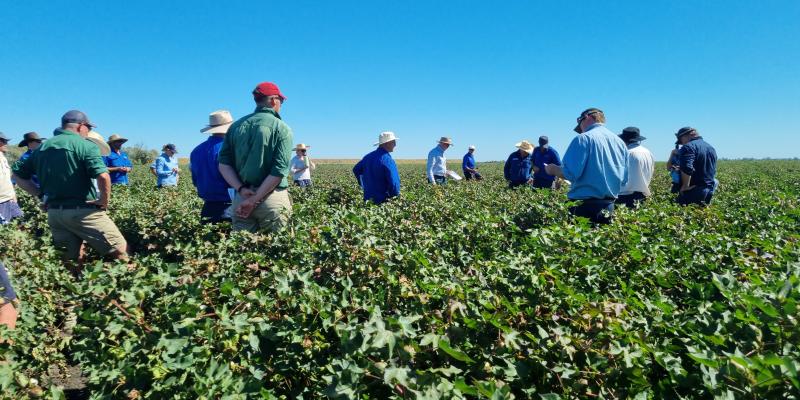
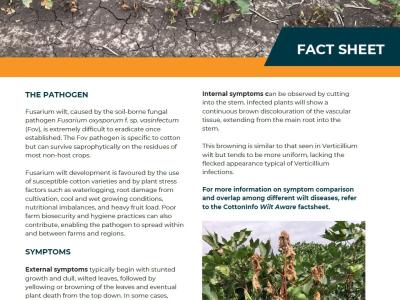
Growers and consultants can conduct their own early and late season disease surveys to monitor and record findings allowing a comparison over time. Farm staff should be trained to look for and report unusual symptoms in the crop. Contact your state department (cotton) pathologist for assistance in identifying and confirming suspected diseases.
Key components of an effective IDM strategy occur throughout the season and include the following:
At planting time
- Optimal seed bed conditions and sowing temperature
- Variety selection
In crop
- Irrigation scheduling
- Agronomic management
- Balanced crop nutrition
- Fungicide use when appropriate
- Monitoring for disease presence or changes
Post-harvest
- Controlling alternative hosts and volunteers
- Manage crop resides appropriately
- Use crop rotations to help reduce disease inoculum in the field
Year round
- Managing insect vectors
- Farm biosecurity and hygiene
More information on these different strategies can be found in the Cotton Pest Management Guide.
- Monitor crops for disease symptoms and know what diseases are present. Consider doing a disease survey within your fields to track the severity and incidence of disease over time.
- Send in disease samples to the industry pathology services when unusual or new symptoms are present to confirm the pathogen. See below on how to collect and send plant samples for diagnostics.
- Ensure all farm personnel, contractors and visitors, where possible, are made aware of diseases on farm and unusual disease symptoms are reported.
- Where pathogens are known to be present, plant resistant varieties where possible to assist in controlling diseases.
- Implement an integrated disease management strategy across the whole farm, with tactics including optimal planting date and temperature, nutrition and irrigation.
- Control weeds, volunteer and ratoon cotton throughout the year.
- Manage crop residues and consider crop rotations based on best practice for diseases present in the field.
- Ensure vehicles, equipment and people have followed Come Clean Go Clean and farm biosecurity procedures.
visit the myBMP Disease Management module for more information on disease management
Sending well-prepared plant samples enables industry pathologists to accurately identify the pathogen or disease affecting your crops. In contrast, poorly collected samples may arrive mouldy or deteriorated, leading to inconclusive results. Missing or incomplete submission forms can also leave pathologists without critical information, such as disease symptom details or your contact information. By collecting and sending samples correctly the first time, you increase the chances of receiving a clear diagnosis, helping you to effectively manage the disease sooner.
A CottonInfo video on Collecting samples for disease testing looks at the process of taking plant samples and the appropriate packaging to send them for diagnosis. You can also find a factsheet on collecting plant samples and the plant diagnosis form needed for sending samples to your state pathologist (contact details found below).
Pathologist contacts & Disease Diagnostic Submission Forms
NSW
- Dr Chi Nguyen
Phone: 0450 634 108
Email: chi.nguyen@unisq.edu.au POSTAL ADDRESS: Attention Chi Nguyen, The University of Sydney, I.A Watson Grains Research Centre E12,12656 Newell Highway, Narrabri NSW 2390
QLD
- Dr Dinesh Kafle
Phone: 0436 622 940
Email: dinesh.kafle@dpi.qld.gov.au POSTAL ADDRESS: Attention: Dinesh Kafle, Ecosciences Precinct, B3 Loading Dock, Joe Baker Street, Dutton Park QLD 4102
NT
WA
- Sarah Nolan
Phone: 0477 838 712
Email: sarah.nolan@dpird.wa.gov.au HAND DELIVERY: The diagnostic lab is based in the growing region so do not send samples sent by mail. Sarah will pick them up or they can be dropped off directly to - Frank Wise Institute of Tropical Agriculture, Durack Drive, Kununurra, WA 6743
CottonInfo Technical Lead
- Sharna Holman - Technical Lead for Biosecurity and Disease
Phone: 0477 394 116
Email: sharna.holman@dpi.qld.gov.au
Resources
Disease diagnostics
Australian Cotton Disease Collaboration
Verticillium wilt information
Fusarium wilt information
Black root rot information
Cotton bunchy top
Reniform nematode
Other cotton diseases
Remember farm biosecurity is an important aspect of disease management, with prevention better than a cure. For the more information on biosecurity and Come Clean.Go Clean. best management practices, see the Biosecurity page.