Protect the effectiveness of today's insecticides - stay up to date with resistance monitoring and surveillance.
Protect the effectiveness of today's insecticides - stay up to date with resistance monitoring and surveillance.
Insecticide resistance is a reduction in the susceptibility of a pest population to a particular insecticide or insecticide group.
The change is heritable, and natural selection can result in a rapid increase in the proportion of the population with resistance, leading in inadequate control of the pest at the insecticide's registered rate. An incursion of resistant exotic strains of our endemic pests could also introduce resistance to into local populations.
It is important to scientifically confirm suspected cases of insecticide resistance as field 'spray failures' can be due to inadequate coverage or other application issues, including water quality or incompatible product mixes.
To help maintain the sustainability of broadacre production systems, Research and Development Corporations (CRDC and GRDC) support insecticide resistance surveillance programs of major pest species, including Helicoverpa, aphids, mites, mirids and whiteflies.
Focused on detecting resistance to key insecticides used against these pests, these programs provide growers and advisors with an early warning system for potential resistance outbreaks, help maximise the effectiveness of spray applications, and are essential for informing ongoing review and improvement of industry-endorsed resistance management strategies.
This predictive capability means industries can implement management tactics for reducing economic losses well before spray failures occur, as well as minimising further spread of resistance genes throughout the wider pest population.
NSW DPI conducts ongoing Helicoverpa insecticide resistance surveillance program in the major summer cropping regions of NSW and Queensland using F2 screening which is extremely sensitive for all types of known and novel resistance even when resistance genes are recessive. NSW DPI also conducts resistance testing for aphids, mites and mirids.
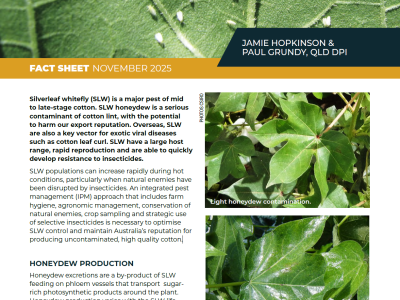
Queensland DPI staff make collections of silverleaf whitefly during the latter half of the cotton season on farms in Queensland and NSW, establishing and maintaining colonies for resistance testing of commonly used products.
Stay updated with our latest industry news
Stay updated with our latest publications