From the ground up: it all starts with the soil.
From the ground up: it all starts with the soil.
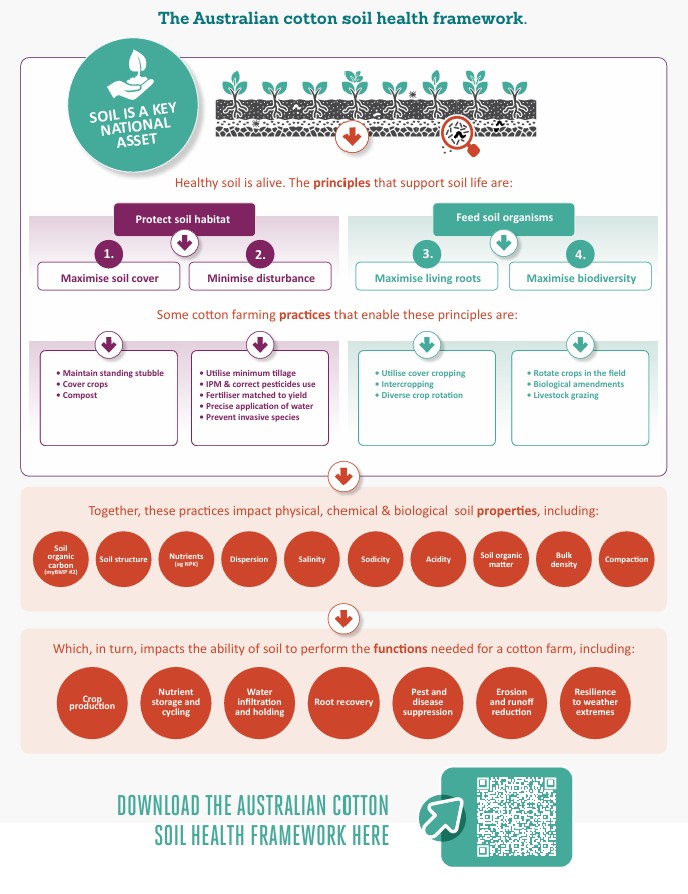
Soil, and especially a healthy soil, is the starting point for productive agriculture and the foundation of all terrestrial life. It underpins the fertility and productivity of a farming business, providing cotton plants with support and access to water, oxygen and nutrients. Farming practices impact physical, chemical, and biological soil properties, which in turn impact the ability of soil to perform the functions needed for a cotton farm. These functions include nutrient cycling and storage, water infiltration and holding capacity, root exploration and resilience to weather extremes, pest and disease suppression and reducing erosion and runoff.
The key components to soil heath are:
Soil organic matter and soil carbon: soil organic matter is composed of dead and decomposing plant material, soil biota (fungi, bacteria, worms etc.) and animal waste. Soil organic carbon is a component of the soil organic matter and the role this carbon plays is important for all three aspects of soil fertility:
Subsoil constraints: subsoil constraints are soil properties that limit or restrict the cotton plant from meeting its water and nutrient requirements. An ideal soil for cotton production has good infiltration and internal drainage, high plant available water capacity (PAWC), good soil structure for root growth and development, optimum pH, low salinity, balanced nutrient availability, low sodicity and adequate soil biota. Problems associated with subsoil constraints include compaction, soil dispersion, high or low pH and waterlogging. These problems can result in poor plant growth, loss of bolls and poor boll set, reduced yields, erosion, increased land management costs and other management issues.
Sodic soils: sodic soils have too high a proportion of sodium. This excess of sodium in soil reduces the strength of bonds that hold clay particles together within aggregates. The sodium also attracts water molecules more readily than other cations, which forces the clay particles apart, causing what is known as dispersion, which causes the soil structure to collapse. Many of the soils used for cotton production in Australia, are sodic or strongly sodic below a depth of 0.5m. This affects root growth and uptake of water and nutrients. Groundwater used for irrigation can cause sodicity problems particularly when the water contains high sodium levels relative to calcium.
Saline soils: saline soils contain excess salts in the soil solution (the liquid in soils held between the soil aggregates). When the concentration of salts in the soil solution exceeds that found in the plant roots, water flows from the roots back into the soil, so that the plant is unable to obtain sufficient water even though the soil is moist.
Compaction: compaction restricts root growth, reducing the availability of nutrients and water to the cotton plant. Soil compaction can also increase denitrification, further reducing the availability of nitrogen. Some compaction is an inevitable consequence of using heavy machinery on soils, but impacts can be minimised by implementing good management practices, minimum tillage, controlled traffic and guidance systems.
Waterlogging: waterlogging, particularly following surface irrigation, can impact significantly on cotton production, causing problems such as denitrification, boll shed and reduced boll set.
Soil pH: soil pH is a measure of the acidity, neutrality, or alkalinity of the soil solution. pH directly influences the availability of soil nutrients to the cotton plant. Most cracking clay soils are alkaline (pH 8.0 to 8.5), which affects the availability of many micronutrients.
Soil mycorrhiza: soil mycorrhiza (also referred to as AM) are soil-borne fungi that attach themselves to the growing roots of crops. They can allow roots to scavenge more effectively for nutrients, particularly phosphorous and zinc, which are immobile in the soil. AM fungi survive well in dry soils but can decline if the soil undergoes cycles of wetting and drying without a host plant being present. AM can also be reduced in some systems following non-mycorrhizal crops like canola. Low AM colonisation is a symptom of cotton long fallow disorder but is not a cause.
Stay updated with our latest industry news
Stay updated with our latest publications
Stay updated with our latest events